The Plug-In Solar Consumer Guide aims to educate consumers on how plug-in solar panels work by providing guidance on safety standards, state-by-state legislation, installation requirements, and potential energy savings. This guide is co-authored by Solar United Neighbors (SUN), a vendor-neutral national nonprofit (c3) dedicated to helping people go solar, join together and fight for their energy rights and Bright Saver, a national non-profit focused on advancing plug-in solar accessibility through policy change and by providing at-cost zero-markup plug-in solar kits directly to the public.
Plug-in solar panels provide a simple, reliable, and affordable way to save money by generating your own electricity. Panels convert sunlight into electricity and plug in directly to a power outlet. This is different than the rooftop systems you may be familiar with. Those systems connect to your home through your electric panels. Plug-in solar lets you go solar without a complicated installation. Small scale plug-in systems can be placed on a balcony, in a front or backyard, or on a roof deck, which is why these systems are sometimes called “balcony solar.” These portable plug-in solar systems are easy to set up and take down if your lease is up, or you’re moving into a new home.
Plug-in systems vary in how much electricity they generate. A typical system should cover a small air conditioner and, depending on the size, a few other appliances. By comparison, a typical home rooftop installation will be between 3,000–9,000 watts, often covering the majority of a home’s electricity consumption. Plug in systems cost between a few hundred and a few thousand dollars, depending on the size and whether there is a battery. Pairing a battery with your plug-in solar can help you store electricity that can later be used to charge your phone or power your fridge if the power goes out.
Popular throughout Europe, plug-in solar is not yet widely available across the U.S. This is because U.S. state laws require plug-in solar to go through the same permitting and utility approval process that rooftop systems do. This unnecessary red tape drives up the cost of plug-in solar.
This is rapidly changing. As of October 2026, ten states — Utah, Maine, Virginia, Colorado, Maryland, Vermont, New Hampshire, New Jersey, Connecticut and California— have passed legislation to allow residents to use plug-in solar. These laws establish safety standards and utility approval exemptions to make it easy for people to buy and use plug-in solar systems. More than 30 other states and D.C. have introduced similar legislation in 2026, with more planning to do so in 2027. If you want plug-in solar where you live, let your elected officials know.
How does it work and what can it power in my home?
Plug-in solar refers to small (usually less than or equal to 1,200 W) systems that can be plugged directly into an outlet. They work by converting sunlight into electricity. They can be mounted on the ground, alongside a fence or building, outside a window, or on a deck or balcony.
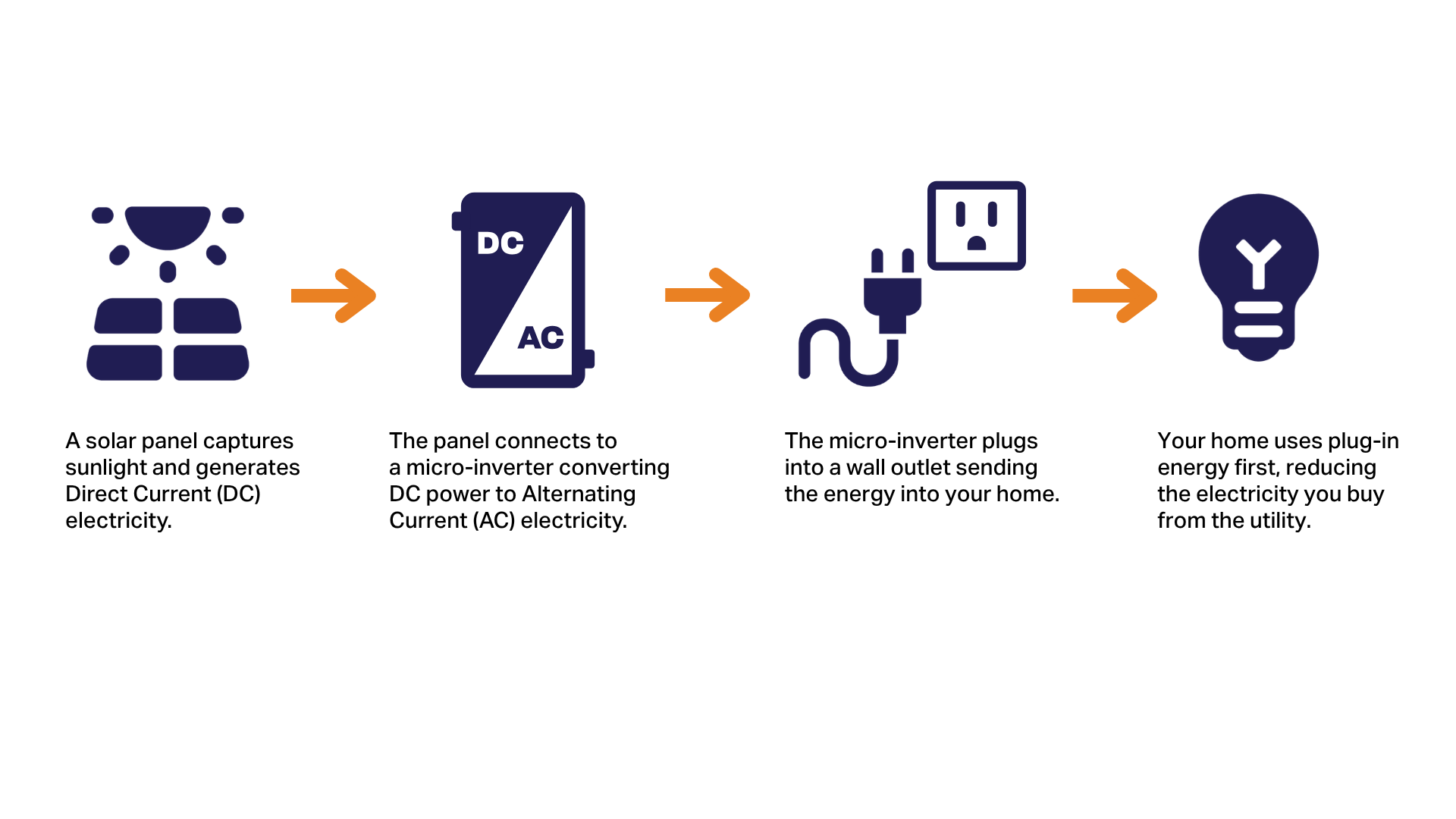
Sunlight hits the panel and produces an electric current. This current, called Direct Current (DC), then flows to a device attached to the panel called a microinverter. The microinverter converts the DC electricity to Alternating Current (AC). This is needed because your home and its devices, such as your refrigerator or vacuum, run on AC. The current flows to a plug and into a wall outlet, sending the energy to your home.
Electricity not used by your home or appliances can be stored in a battery or safely shared with your neighbors.
Consumers should only use systems that are certified by UL or another nationally recognized testing laboratory.
Notify your utility or landlord if required.
This will vary by state and/or utility.
Check your local building codes and neighborhood regulations if you are part of a Homeowners Association or Condo Owners Association, or similar group.
When used properly and in compliance with safety standards, plug-in solar is as safe as a hair dryer and other common household appliances.
Plug-in solar laws require the systems to be certified by Underwriters Laboratories (UL) or another nationally recognized testing laboratory. In the United States, OSHA uses the term “Nationally Recognized Testing Laboratory” (NRTL) to refer to private sector organizations that perform product certification. The most prominent NRTL is UL Solutions, often abbreviated as “UL”. This is the standard for nearly all U.S. electrical devices. UL is the most prominent NRTL, and is a private company that tests and sets safety standards in electrical products, ranging from lightbulbs, phone chargers, to washing machines. UL released certification criteria for plug-in systems on December 11, 2025, known as UL 3700. This certification for plug-in solar photovoltaic systems guides manufacturers and consumers on how to safely use this product. Although legislation has passed in several states, no plug-in systems in the U.S. have received a certification from UL or NRTL. A handful of state laws allow systems under 391 W to be installed without changing the building’s hardwiring. Learn more here.
Plug-in solar systems have a built-in microinverter that shuts the solar system down within milliseconds in the case of a power outage. This is a safety measure to protect consumers and lineworkers. It eliminates the risk of electric shock during plug-ins and unplugging.
As with any electrical device, plug-in solar users must observe common-sense guidelines. This means not bypassing circuit breakers and not plugging in too many appliances into the same circuit.
Is plug-in solar available where I live? When will it be available?
Currently, the availability of plug-in solar systems varies state-by-state. So far, several states have passed the necessary legislation to open up the market to consumers.
As of September 2026, the following nine states have passed legislation that sets safety standards for manufacturers and retailers and removes outdated regulatory barriers to consumers. This chart lists the important details such as when the bill will go into effect, system size, utility notification, and exemptions from certain installation requirements for small systems (391 W or below are not required to change the building hardwiring).
Systems must be certified by UL or an equivalent nationally recognized testing laboratory. Must meet the most recent version of the NEC. Inverters must be UL1741 certified and IEEE1547 compliant.
Utilities are not liable for damages caused by these devices.
Size limits for output (AC): Customers may install one 420W system per service address. The law requires an electrician for anything above 420 W up to 1200 W.
System requirements:
Customers must notify the utility for plug-in solar systems exceeding 420 W within 30 days off the installation.
Notification to include customer address, inverter capacity, and compliance statement.
Systems must be certified by UL or an equivalent nationally recognized testing laboratory.
UL 3700 or an equivalent certification by a nationally recognized testing laboratory; in compliance with IEEE 1547-2018 and any successor standard using default performance and setting profiles consistent with those developed by regional transmission and distribution system operators.
Must be connected to systems using smart meters.
Customers must ensure the device is temporarily but securely attached to the ground or a structure.
Customer with a net metering system cannot install a plug-in device.
Utility can recover costs associated with overloading of the service provided due to presence of plug-in device.
Includes plug-in in solar rights laws, preventing HOAs or condo boards from prohibiting installation.
Tenant to provide 10 days notice to the landlord before install; landlord must reply in 10 days with any reasonable restrictions, including the tenant paying for electrical work and hiring an electrician for that work. If the landlord does not respond in ten days, the tenant may install. The tenant cannot perform or hire someone to do electrical work without landlord’s permission. Landlords do not have to perform or pay for any work to allow for plug-in solar to be installed.
Size limits for output (AC): 1200 W; The law allows customers to use plug-and-play systems under 391 W without changing a building’s hardwiring.
System requirements:
Systems must be certified by a nationally recognized testing laboratory and meet current NEC standards.
Customers must notify their electric provider before installation. Electric service providers have 15 days to review the form for completeness and accuracy; it is presumed complete if the customer does not hear back in that time frame.
Requires tenants must get permission if installation requires changes to the building’s wiring or premises. Otherwise, landlords who have more than four units may not prevent installation. They can impose reasonable restrictions on where a plug-in system is placed.
Size limits for output (AC): 1200 W; The law allows customers to use plug-and-play systems under 391 W without changing a building’s hardwiring.
System requirements:
Systems must be UL 3700 listed or certified, or comparable standard by a nationally recognized testing laboratory and meet current NEC standards.
Includes plug-in in solar rights laws, preventing HOAs or condo boards from prohibiting installation.
A tenant must provide written notice at least seven days before installation to the landlord, HOA, COA, or cooperative housing corporation. It must include documentation that the device meets safety requirements, and; the proposed location of the device. The landlord may respond to the tenant’s notice with any reasonable restrictions concerning the physical dimensions, placement, or manner of placement of the device.
A tenant shall be responsible for any damages sustained to a premises as a result of a portable solar generation device.
No municipality can prohibit or require a permit, application, fee, or license for plug-in solar.
Systems must be UL 3700 listed or certified, or comparable standard by a nationally recognized testing laboratory and meet current NEC and California Electrical Code.
Utility may require a customer to use a simple online notification form that includes address, make, model, and size of device.
Systems are exempt from interconnection requirements, utility fees and charges until January 1, 2030.
Looking ahead
We expect more states to legalize plug-in solar systems in 2027. Manufacturers need time to comply with a patchwork of state regulations and delays in national certification application approval are already impacting product development and availability in states where the legislation has already passed.
More than 4 million plug-in solar systems have been sold in Germany. Consumers there can buy them online and at major brick-and-mortar retailers. Americans want plug-in solar to be available now in the U.S., but state lawmakers need to cut red tape to make that happen.
How much will a plug-in system save me in electricity costs?
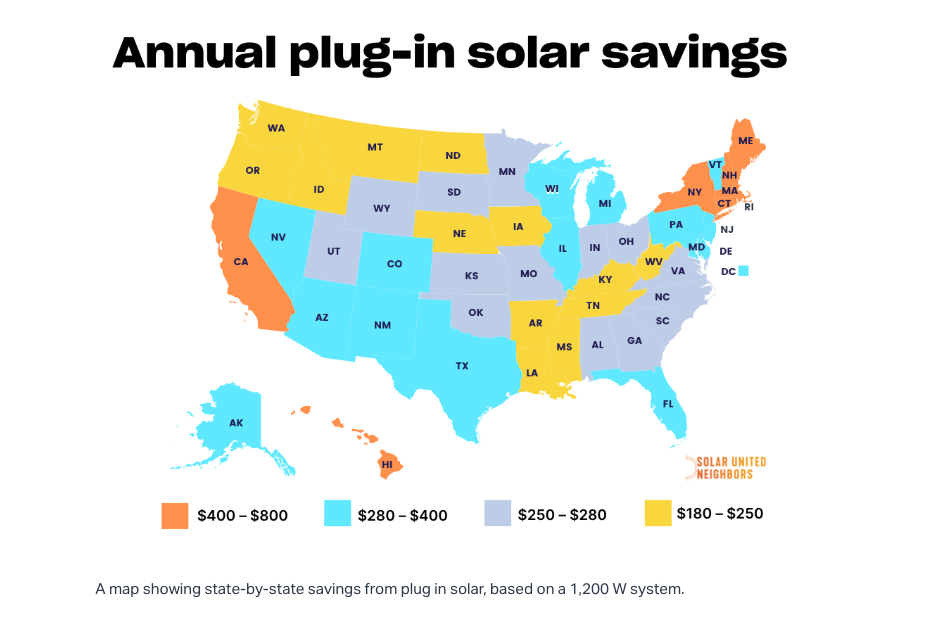
A typical plug-in system can cut your electricity bills by several hundred dollars per year. The average payback time for a system purchased today is about five years. The cost for plug-in solar is forecast to drop from nearly $3/watt today to just under 60¢/watt within 2-3 years of enabling legislation in a critical mass of states. They can generate up to 1,200 W, enough to power a large refrigerator, and cost between $400–$2,000. As electricity prices skyrocket nationwide, these solar panels are an easy way for families to lower their energy bills and take charge of their energy. See the map below for estimated savings in your state.
The calculations for this map combine data from the U.S. Energy Information Administration (EIA) on average state electricity price from September 2025 and PVWatts, a solar output estimator. It uses PVWatt’s estimate of how much solar a plug-in system generates in the largest city by population in each state. These are savings averages for each state.
Consumers that purchase a certified plug-in solar system should follow the manufacturer’s installation instructions. A system that is certified by a nationally recognized testing laboratory (NRTL) that eventually makes its way into the U.S. market will provide clear instructions as to what can be self-installed and by whom.
Unfortunately, it is not yet clear if you will need to hire an electrician for plug-in solar. UL 3700 is the first certification standard in the U.S. available for plug-in solar systems. Some manufacturers have already applied to meet the current specifications, but, as of late July 2026, we are only aware of a few plug-in system components that are certified under UL 3700. No all-in-one plug-in solar kit in the U.S.—sold as a single box containing a panel, inverter, and plug—has received a complete system-level NRTL certification. Hopefully this will change soon. Different state bills contain language about plug-in solar products being UL-certified if they are above a certain size threshold. We anticipate that there may be a UL requirement to have a qualified person install a special electric outlet (also referred to as a “safety receptacle”) for systems above a certain size. A qualified person can be, but isn’t necessarily, an electrician.
Requiring a unique plug-in photovoltaic (PV) plug or receptacle can make plug-in solar less accessible as it means people could not buy and plug-in the panels themselves (without hiring a professional). It also raises the cost to use plug-in solar. Further, renters usually cannot modify the electrical wiring of their rented spaces. This is why we are advocating for a way for customers to buy and use plug-in solar on their own in state legislative language.
Putting a specific UL 3700 requirement into statute is problematic as the technology quickly evolves or UL or NEC guidance is updated in the future. Maine requires an electrician for any system above 420W. In Virginia, Maryland, and Colorado, residents will be allowed to buy a plug-in solar system up to 391W without changing the building’s hardwiring, making solar easily accessible to renters. These 391W exemptions lack a requirement for product listing certification; however, we recommend that at least all components be UL or NRTL certified.
As of October 2026, residents in four states (Virginia, Maryland, New Jersey and Colorado) will be able to use plug-in solar systems up to 391 watts without hiring an electrician to install a dedicated circuit or to make any alterations to the building’s electrical wiring, once their plug-in solar bills become law. Before installing a system, you should check with your landlord and local regulations for permission and compliance.
Tell your landlord that you plan to purchase a plug-in solar system and where you plan to place it.
Confirm with your landlord that your liability for any damages is clearly outlined in your lease agreement.
While plug-in solar may have been legalized in your state, in some cases, landlords may push back on plug-in solar installation. Colorado, New Jersey and Virginia passed laws that included renter protections to allow for the renters to safely install plug-in solar in their units. It is important to follow the manufacturer’s installation instructions and to make sure you’re complying with your lease agreement.
Some states require plug-in solar owners to notify their utility company. The requirements will vary from state to state, as will the information you need to share, when you need to share it, and how you should submit it (either online or by mail). No penalty or fee should be charged to the customer for this system.
No, this risk is fully addressed by the new UL standard. As soon as the grid goes down, the plug-in solar system’s inverters automatically stop producing power so it cannot send electricity to the power lines. UL guidance requires plug-in solar systems to comply with UL 1741 and IEEE 1547 — the same standards used for all grid-connected solar. When a power outage is detected, the system must automatically stop exporting electricity within 160 milliseconds. This happens without any action required from the homeowner. This functionality, which is crucial to the safety of traditional rooftop solar systems as well, has been a required feature of this equipment for over 25 years.
This will depend on if specific language is included in legislation that is passed in your state. Right now, Colorado and New Jersey are the only state that prevents HOAs from prohibiting plug-in solar; however, they may require reasonable restrictions for installation. This includes the location of the device, prior notice of installation of the device, restrictions to prevent overload of electrical systems, and securing the system to your home, patio or balcony.
Plug-in solar is primarily designed for folks who aren’t able to use rooftop solar . It may also be an option to expand your solar system if your electrical panel has room for more solar. We’re waiting for pending national certification to determine how these systems will work with your rooftop solar and what guidelines there will be.
Adding plug-in solar is theoretically easy because plug-in solar kits are designed to be as simple as plugging in a toaster. But from a utility and regulatory perspective it may not be so easy. Because you already have a solar system, adding a plug-in solar kit could actually trigger more red tape than you might expect. When your original system was installed, you (or your installer) signed an Interconnection Agreement with your utility. This contract specifies the exact size of your system. If you add more generation you are technically modifying that agreement.
In some cases, there may be an explicit exception. For example, in California, rooftop solar customers are allowed to add up to 1 kW without needing a new interconnection agreement. This preserves your original net metering rate when you add a plug-in system. Check your state or utility provider for their particular rules. Reach out to our free Solar Help Desk for help.
Many DIY solar enthusiasts are interested in creating their own plug-in solar systems. By building your own, you are liable for any damages if your system is faulty or were to cause a fire or other damage. By using a product with safety features and a safety certification, you remove your liability and a plug-in solar system becomes more like a microwave or other appliance.
No. In some rare circumstances with an older electric meter, your meter may read electricity going to the grid as coming from the grid. With the small size of plug-in solar units, we expect that only at most 10% of the electricity that you produce could be exported to the grid. Even in a worse case scenario, you may save 80% as much as expected, but plug-in solar will still save you money.
To check if you have the right electric meter compatible for plug-in solar, go take a look at the face of your electricity meter. For plug-in solar, you’ll need a smart meter (AMI) that can detect two-way electrical traffic. According to the EIA, more than 119 million homes and businesses had smart meters in 2022. These meters have an LCD screen that will have arrows to show the directions of electricity and constantly cycle through different data points every few seconds.
If you live in an area that underwent an early smart meter rollout in the mid-2000s to early 2010s, and your utility hasn’t updated the hardware since, you most likely have a solid-state digital meter which is problematic for plug-in solar. These will read the power entering the home from your plug-in solar panel as “usage” rather than production. They will have a basic digital LCD screen and only display one number (total lifetime kWH).
In rare cases, you might have an old meter that is analog if it has a spinning silver disc and clock-like dials, and will spin backward if plug-in solar is used and will result in recording lower electricity usage.
While manufacturers will likely release specially labeled “bidirectional” GFCI receptacles in the future, it is important to follow the manufacturer’s specific instructions for your equipment. Manufacturers anticipate GFCI’s to be tested/approved/certified for bidirectionality and bundled with certified inverters soon.
Requiring a “special plug” and receptacle can make plug-in solar less accessible as it removes the DIY aspect and raises costs of installation. As with any electrical device, plug-in solar must follow the manufacturer’s instructions, observe common-sense guidelines, not bypassing circuit breakers or not plugging in too many appliances into the same circuit. Do not use extension cords or power strips.
According to technical experts, American electric systems are designed with split phase in mind and there is an expectation that the phases will not be balanced. All plug-in solar inverters work with UL 1741 and are approved for this usage and work reliably.
If you add electric generation like plug-in solar to a household circuit with larger loads (e.g. microwave, dryer, toaster oven), then you could overload parts of your electric wiring. The addition of generation can mask or hide the overloaded wiring so the breaker box does not trip the circuit off. This could cause wiring to overheat. This is why larger plug-in systems may require a dedicated electric circuit. For smaller size plug-in systems, this is less of a concern. However, it is good practice to check the circuit that you will use for plug-in solar and make sure it only includes smaller loads (e.g. LED light bulb, TVs, computers, and other electronics). You can check the circuit by turning it off at the breaker box and then seeing which electric devices/outlets lose power.
Yes, you can store energy in a battery made to connect to solar panels. This allows you to power devices when power from the electric grid goes out. Depending on the battery’s capacity, you can power a few appliances, such as a fridge and/or charge your phone.
Each system will have their own warranty depending on the product and manufacturer. Some microinverters have a 12-year warranty.
SUN does not sell plug-in solar kits and is vendor neutral. SUN is considering offering plug-in solar co-ops which would be similar to our rooftop solar co-ops. A solar co-op brings together 50-100 of your neighbors interested in going solar to leverage their buying power for group discounts on home solar installations. In July, two inverters (Hoymiles and APsystems EZ 1) received a UL 3700 subassembly certification from the CSA Group. This means that the inverter meets all applicable UL 3700 requirements for this component, allowing them to check off the inverter portion during a subsequent whole-system certification. As of August 2026, no plug-in systems being solar today have received a whole-system NRTL certification (sold in one box that includes a panel, inverter and plug).
We have not found any grants/incentives for the consumer for plug-in solar available yet. This is most likely due to the fact that plug-in solar is not legal in all states and that plug-in solar has not yet been standardized or certified for use in the U.S.
Get the latest on solar straight to your inbox.
Fight for your solar rights.
Everyone has the right to go solar. Spread the sunshine nationwide and in your local community by taking action, joining events, and more.